


Women Shoes
Insights into the Luxury Shoe Market Dynamics

We begin our comprehensive industry report by examining the high-value footwear sector. This analysis provides crucial understanding of a rapidly evolving landscape where premium brands compete for consumer attention.
The global market for premium footwear represents a significant economic force. Recent valuations place this sector at over $35 billion, with projections showing continued expansion through the next decade.
Our report details how this industry is expected to grow at approximately 7% annually. This steady increase reflects changing consumer preferences and economic factors influencing purchasing decisions.
We explore the drivers behind this sustained growth. Disposable income levels, demographic shifts, and evolving fashion trends all contribute to rising demand for quality products.
This introduction sets the stage for deeper examination of regional performances and product segmentation. We’ll analyze how different categories, from formal styles to casual designs, capture varying consumer interest.
Our findings offer strategic insights for brands, retailers, and investors operating in this competitive space. Understanding these patterns is essential for navigating the future of premium footwear.
Executive Summary: The State of the Global Luxury Footwear Industry
Our analysis synthesizes the latest data to present a clear snapshot of the high-end footwear landscape.
This overview captures the essential forces shaping this multi-billion dollar sector.
Regional performance is a defining feature. North America commanded a 29.0% revenue share in 2023, solidifying its position as the leader.
High disposable income and concentrated wealth in this region fuel consistent demand. Europe follows as the established second-largest arena.
Its deep heritage in fashion houses supports a strong and growing appetite for premium products.
Examining the product landscape reveals clear consumer favorites. The fashion segment led all categories, capturing over 40% of total revenue.
This highlights a primary consumer desire for stylish and versatile designs in their purchases.
When analyzing end-users, women’s footwear represents the largest single segment. It held a 46.9% share of the global total.
However, the men’s category is currently experiencing a faster rate of expansion, indicating a shifting dynamic.
The way consumers acquire these goods is also critical. Despite the rise of online shopping, physical stores remain dominant.
Offline channels, including boutiques and department stores, accounted for 75.6% of all distribution last year.
Several powerful factors are propelling this sector forward. Rising personal income remains a fundamental driver.
The influence of younger generations and continuously evolving fashion trends also play major roles.
This growth does face headwinds. High economic sensitivity and the issue of counterfeit goods present ongoing challenges.
Leading brands are responding with focused strategies in innovation and sustainability to secure their future.
Market Size and Growth Trajectory: A Robust Expansion
Quantifying the economic scale of premium footwear reveals a sector on a powerful upward climb. This section details the current valuation and projected path for this high-value industry.
Current Valuation and Future Projections
The global luxury footwear market demonstrates substantial financial heft. Recent estimates place its value between USD 35.72 billion in 2023 and USD 41.29 billion by 2025.
Our analysis of 2024 data calculates the size at approximately USD 38.66 billion. This consistent upward revision reflects strong underlying demand and a healthy industry.
Looking ahead, projections indicate remarkable expansion. Consensus points toward the market reaching about USD 57.38 billion by 2030.
The long-term forecast is even more impressive. By 2034, the sector is estimated to hit between USD 76.34 billion and USD 76.48 billion.
The United States represents a critical component of this global growth. Its domestic market was valued at USD 8.31 billion in 2024.
American expansion is projected to be particularly vigorous. We expect it to be worth around USD 16.56 billion by 2034, effectively doubling in a decade.
Several powerful factors fuel this expansion. A key driver is the growing population of high-net-worth individuals.
In the U.S. alone, there were approximately 618,000 millennial millionaires in 2019. This demographic prioritizes quality and brand prestige in their purchases.
Regional performance variations significantly shape the overall figures. North America’s dominance and Asia-Pacific’s rapid ascent both contribute to the positive outlook.
Innovation in specific product categories also boosts valuation. Sneakers and sustainable designs are capturing greater consumer interest and spending.
Economic elements like disposable income growth remain fundamental. Wealth concentration in key markets provides a stable foundation for continued development.
These projections carry important implications for all stakeholders. Brands, investors, and retailers must plan long-term strategies around this growth.
Understanding this trajectory is essential for securing a competitive position. The footwear industry is poised for a transformative forecast period.
When contextualized within the broader luxury goods sphere, premium footwear shows distinct growth characteristics. Its path is marked by both resilience and significant opportunity.
Key Growth Drivers Propelling the Market Forward
The sustained expansion of the premium footwear industry stems from a combination of demographic shifts and economic trends. We identify several interconnected forces creating powerful momentum for this sector.
These catalysts work together to accelerate development and reshape consumer behavior patterns. Our analysis reveals how each factor contributes to the overall growth trajectory.
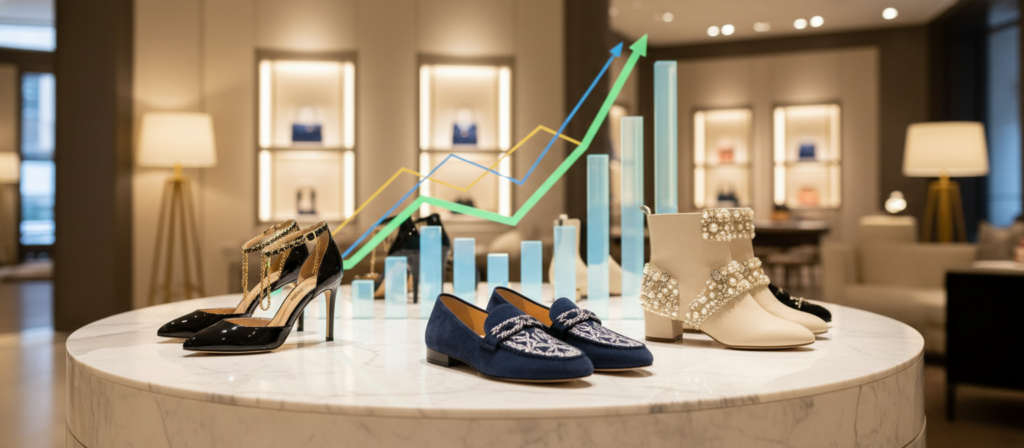
Rising Disposable Income and Wealth Concentration
Increasing personal wealth forms the fundamental foundation for sector growth. Global disposable income levels continue their upward trajectory, particularly in emerging economies.
This economic prosperity creates entirely new consumer bases for premium footwear brands. Wealth concentration among high-net-worth individuals (HNWIs) significantly amplifies this effect.
North America demonstrates remarkable wealth density. According to Wealth-X data, this region housed 41% of the world’s HNWIs in 2019.
This concentration creates a powerful core of purchasing power. The demand for high-quality products naturally follows increased financial capacity.
The Millennial and Gen Z Influence
Younger generations are reshaping consumption patterns across the premium landscape. Their values and spending habits differ markedly from previous cohorts.
Millennials represent a particularly influential demographic. In 2019, the United States alone had approximately 618,000 millennial millionaires.
Close to 93% of this group held net wealth between $1 million and $2.5 million. This demographic prioritizes experiences and visible symbols of success in their purchases.
Generation Z brings distinct preferences to the table. They show strong inclination toward sustainable, experiential, and digitally-native products.
Both groups value authenticity and brand storytelling. The HENRY (High-Earners-Not-Rich-Yet) segment within these generations represents a crucial target for brands.
Evolving Fashion Trends and Brand Consciousness
Fashion evolution continuously expands the boundaries of the premium footwear sector. The casualization of luxury represents one of the most significant shifts.
Sneaker culture has transformed from athletic wear to high-fashion statement. This trend brings new consumers into the premium category who might not purchase traditional formal styles.
Brand consciousness remains a powerful driver across all demographics. Recognizable names like Louis Vuitton, Gucci, and Chanel serve as status symbols.
Consumers increasingly seek to showcase various international brands. This inclination toward brand flaunting stimulates consistent product demand.
Social media and digital platforms accelerate fashion cycles dramatically. They create new demand patterns and make trends instantly accessible to global audiences.
Premium footwear often serves as an entry point to luxury brands. Its relatively accessible price points compared to handbags or jewelry lower the barrier for new consumers.
These drivers create compound growth effects throughout the industry. Demographic shifts amplify the impact of favorable economic factors.
The interaction between these elements ensures sustained momentum. Brands that understand these dynamics position themselves for success in the coming years.
Primary Market Restraints and Challenges
Despite optimistic projections, several critical challenges constrain the full potential of this sector. Our analysis identifies key hurdles that premium brands must navigate to maintain their trajectory.
These restraints create friction in an otherwise expanding landscape. They affect everything from consumer access to brand integrity across the global luxury footwear market.
High Price Points and Economic Sensitivity
Elevated cost structures create inherent limitations for premium footwear. The exclusivity of these items naturally restricts the addressable consumer base.
Even with growing wealth concentrations, the pool of potential buyers remains finite. This fundamental constraint shapes the entire footwear market strategy for leading brands.
Economic sensitivity presents another significant hurdle. Purchases in this category are often the first discretionary expenses cut during downturns.
When uncertainty rises, consumers prioritize essentials over premium items. This pattern creates substantial volatility in demand across economic cycles.
Trade policy fluctuations add further complexity to production costs. Brands sourcing materials or manufacturing globally face unpredictable expense increases.
Supply chain disruptions from geopolitical tensions also affect timelines. These factors compound the challenge of maintaining consistent quality and delivery.
Maintaining exclusivity while pursuing growth requires careful balance. Brands must limit production to preserve prestige while expanding their presence.
This tension between scarcity and scale defines strategic planning. It influences decisions across the footwear industry during the forecast period.
Sustainability expectations introduce additional cost pressures. Traditional leather production faces environmental scrutiny from conscious consumers.
Developing eco-friendly alternatives requires significant research investment. These expenses ultimately contribute to higher final price points.
The Persistent Threat of Counterfeit Products
Fake goods represent a severe and ongoing challenge for legitimate operators. Counterfeit operations undermine brand value and consumer trust across the sector.
These illicit products divert revenue from authentic manufacturers. They also damage the reputation of premium labels through inferior quality.
Modern counterfeit networks have grown increasingly sophisticated. They leverage digital platforms to reach global audiences with convincing replicas.
Online marketplaces provide anonymity and scale for these operations. This makes enforcement particularly challenging for luxury brands and authorities.
The problem varies significantly by geographic region. Certain markets experience more acute threats from counterfeit networks.
These regional differences require tailored anti-counterfeiting strategies. Brands must allocate resources based on local risk assessments.
Competitive pressure compounds these authenticity challenges. Non-traditional players are expanding into premium segments with substantial marketing power.
Sportswear giants like Nike and Adidas command significant consumer loyalty. Their entry into higher price brackets creates new competitive dynamics.
Consumer education becomes crucial in this environment. Brands must help buyers distinguish authentic products from sophisticated fakes.
Technological solutions like blockchain verification are gaining traction. These tools offer promising approaches to protecting brand integrity.
Ultimately, these restraints interact to shape the competitive landscape. Economic factors influence susceptibility to counterfeit purchases.
Regional variations affect which challenges dominate local markets. Understanding these interconnections is essential for strategic planning.
Our examination reveals a complex environment of competing pressures. Success requires navigating both economic cycles and authenticity threats.
Brands that address these challenges proactively secure stronger positions. They build resilience against the inherent volatility of premium segments.
Analyzing the Core Luxury Shoe Market Dynamics by Segment
Understanding consumer behavior requires examining how the premium footwear market divides across product types, users, and price points. Our segment analysis reveals the underlying structure of demand in this high-value industry.
This breakdown shows where revenue concentrates today. It also highlights which areas promise the most vigorous expansion in the coming years.
Product Segmentation: Fashion, Formal, and Sneakers Lead
Product categories show clear winners in consumer preference. The fashion segment commanded a dominant 40.5% revenue share in 2023.
This category’s success stems from its versatility and strong style appeal. Consumers seek items that transition seamlessly from day to evening wear.
Formal footwear maintains steady demand with professional and occasion-based use. We anticipate this segment growing at a 5.6% CAGR from 2024 to 2030.
The sneaker category represents one of the most remarkable growth stories. Casualization trends and collaborations between premium and sportswear brands fuel this expansion.
Regional preferences influence these product segment performances. Formal styles show particular strength in certain established markets.
Sneaker dominance appears more pronounced in regions with younger, urban populations. These geographic variations require tailored approaches from brands.
End-User Analysis: Women’s Dominance and Men’s Rapid Growth
Examining who buys these products reveals another layer of insight. Women’s footwear held a commanding 46.9% share of global revenue in 2023.
This dominance reflects historical purchasing patterns and collection sizes. Women often own multiple pairs for different occasions and outfits.
The men’s category tells a different story through its growth rate. It represents the fastest-expanding segment with a projected 7.2% CAGR through 2030.
This acceleration signals shifting male attitudes toward fashion and self-expression. Men are increasingly investing in premium items as personal statements.
Children’s premium footwear exists as a niche but growing category. Affluent parents often seek miniaturized versions of adult designs for their children.
Segment interactions create interesting cross-currents. Sneaker growth affects both men’s and women’s categories across various price points.
Price Point Perspectives: The Above $800 Segment and Accessible Luxury
Price segmentation reveals where consumers allocate their spending. The above USD 800 segment dominated total sales in 2023.
This tier represents the traditional core of ultra-premium offerings. It attracts collectors and consumers seeking maximum prestige.
The most dynamic growth emerges in the accessible luxury range. The USD 400 to USD 800 price segment expands fastest at an 8.4% CAGR.
This middle ground attracts newer consumers entering the premium space. It also appeals to those trading up from mainstream brands.
Brands develop distinct strategies for different price segments. High-end collectors receive exclusive limited editions and personalized service.
Accessible luxury consumers encounter different marketing and distribution approaches. These strategies aim to build brand loyalty for future upgrades.
Our forecast period analysis projects how these dynamics might evolve. Current growth rates suggest continued expansion across all segments through 2030.
The interaction between product type, user group, and price creates complex patterns. Successful brands will navigate these interconnections strategically.
Regional Landscape: Dominance and Emerging Opportunities
Our regional analysis uncovers where established powerhouses and emerging forces shape global demand. Geographic performance is not uniform, creating a complex map of consumer spending.
We examine three primary zones driving the global luxury footwear sector. Each region presents unique consumer behaviors and growth trajectories.
North America: The Established Revenue Leader
This region commanded a 29.0% revenue share of the worldwide total in 2023. Its dominance is firmly established.
The United States forms the core of this performance. Concentrated wealth in major cities like New York and Los Angeles fuels consistent purchases.
Strong retail infrastructure supports this leading position. Flagship stores and department outlets provide extensive physical access for customers.
High disposable income levels among consumers are a fundamental driver. This economic foundation ensures resilience even during broader fluctuations.
Europe: A Tradition of Luxury and Fast Growth
Europe is home to historic fashion houses that define premium style. Cities like Paris, Milan, and London serve as global capitals for high-end design.
For European consumers, buying high-priced items satisfies psychological needs for status. The desire for exclusivity is a powerful factor in their decisions.
Brand recognition is exceptionally strong here. According to FootActive, Gucci generates approximately 215,000 online searches monthly as a leading luxury footwear brand.
Domestic consumption combines with robust tourism. International shoppers visit these style capitals, further accelerating market growth.
Countries like Germany and France show particularly strong demand. Their affluent populations have a deep appreciation for craftsmanship and heritage.
Asia-Pacific: The Fastest-Growing Market
This region represents the most dynamic expansion zone in our report. We project a remarkable 7.63% CAGR over the coming years.
Rising middle classes in China, India, and South Korea are creating new consumer bases. Economic development is translating directly into purchasing power.
Brand recognition often takes priority over heritage in many Asian markets. Consumers frequently seek the newest designs from prestigious labels.
Japan presents a unique case with its mature but sophisticated consumer base. It balances appreciation for tradition with enthusiasm for innovation.
Beyond these primary regions, other areas show significant potential. The Middle East has cities like Dubai emerging as major shopping destinations.
Latin America focuses on key nations like Brazil and Mexico. Their growing affluent populations are attracting increased attention from major brands.
Regional consumer behavior differences require tailored approaches. European buyers often value heritage and artisanal quality above all.
Asian consumers may prioritize brand visibility and innovative designs. Understanding these nuances is crucial for success.
Leading luxury footwear brands are adapting their strategies accordingly. They adjust product assortments and marketing messages for each locale.
Retail expansion plans now reflect these regional realities. Physical stores might emphasize heritage in Europe while highlighting novelty in Asia.
This geographic analysis reveals a sector being pulled in multiple directions. Established markets provide stable revenue, while emerging regions fuel the growth forecast.
The Distribution Channel Shift: Offline Strength vs. Online Acceleration
The pathways through which consumers acquire premium footwear reveal a fascinating duality in modern retail. Physical stores maintain commanding presence while digital platforms accelerate their expansion.
Our analysis focuses on this critical junction in the footwear market. We examine how traditional and emerging channels coexist and compete.
Understanding this balance provides strategic insight for all brands and retailers. The distribution channel landscape directly influences consumer access and brand perception.
The Enduring Power of Brick-and-Mortar and Boutiques
Physical retail continues to dominate premium footwear sales. The offline segment held a commanding 75.6% revenue share in 2023.
This dominance reflects several inherent advantages. Brick-and-mortar locations offer experiences digital platforms cannot replicate.
Key strengths of physical stores include:
- Personalized service from knowledgeable staff
- Tactile experiences allowing customers to feel materials and assess fit
- Immediate gratification through instant possession
- Atmosphere and ambiance that enhance the shopping experience
Boutique shops hold particular appeal in this segment. They offer curated selections that create exclusivity and discovery.
These environments excel at brand storytelling. They transform simple transactions into memorable experiences.
Multi-brand retailers serve as important distribution partners. They provide consumers with variety and comparison opportunities under one roof.
Department stores and specialty retailers bridge multiple luxury brands. This approach caters to consumers seeking diverse options.
The Rapid Ascent of E-commerce and Digital Platforms
While currently smaller in share, online channels show remarkable momentum. They are anticipated to witness the fastest CAGR over the forecast period.
Digital platforms remove geographic barriers to access. They enable global reach from a single virtual location.
Major online retailers have established significant presence. Amazon.com, Inc. and Herring Shoes Limited lead this digital expansion.
In January 2020, Amazon announced plans to launch a platform exclusively for luxury fashion. This move signals serious commitment to the premium footwear industry.
Brand-owned e-commerce sites provide direct consumer relationships. They offer complete control over presentation and customer data.
These digital storefronts often complement physical locations. They create seamless brand ecosystems.
Digital innovation extends beyond simple transactions. Advanced features are transforming online shopping:
- Virtual try-on technology using augmented reality
- Personalized recommendation engines based on browsing history
- 3D product visualization for detailed examination
- Live shopping events with brand representatives
Omnichannel strategies bridge online and offline worlds. Services like buy-online-pickup-in-store create flexible consumer journeys.
These integrated approaches recognize that modern shoppers use multiple channels. They seek consistency across all touchpoints.
Regional variations significantly influence channel preference. Online penetration differs across global markets.
North America shows strong e-commerce adoption among younger demographics. Established markets in Europe maintain stronger offline traditions.
The Middle East demonstrates unique patterns with luxury malls and digital innovation coexisting. Asian markets often lead in mobile commerce adoption.
Future channel dynamics will likely see continued online growth. However, physical retail will maintain crucial importance for premium experiences.
The most successful brands will master both domains. They will create complementary rather than competing channel strategies.
This balanced approach recognizes that different consumers prefer different paths. The footwear market ultimately serves diverse preferences through multiple access points.
Competitive Environment and Key Player Strategies
I will_prompt id=”
–
The Impact of AI and Sustainability on Future Market Dynamics
Looking ahead, the intersection of technology and ethics is defining the next chapter for premium footwear. These twin forces are not just trends but fundamental shifts in how products are created and valued.
Our analysis explores this powerful convergence. It reveals new imperatives for brands seeking leadership in the coming decade.
Artificial Intelligence in Design, Production, and Personalization
Artificial intelligence is revolutionizing the creative and manufacturing core of the industry. It brings unprecedented speed and precision to every stage.
In design, AI enables rapid prototyping and sophisticated trend forecasting. Algorithms analyze vast datasets from social media and sales to predict what consumers will desire next.
This moves creation from intuition to informed insight. It allows for the development of eco-friendly designs from the initial concept phase.
Production sees major gains in efficiency and waste reduction. AI-driven systems optimize material cutting with extreme precision.
This minimizes off-cuts and maximizes yield from expensive fabrics and leathers. The result is a more sustainable and cost-effective manufacturing process.
Personalization reaches new heights through machine learning. Algorithms now curate individual recommendations based on deep analysis.
They consider a customer’s purchase history, browsing behavior, and stated style preferences. This creates a uniquely tailored shopping experience.
Brands are actively investing in this technology. In September 2023, Vibram launched a new AI-driven website in partnership with Salesforce.
This platform enhances the customer journey with intelligent product discovery. It represents a significant step in the digital transformation of the footwear industry.
Sustainable Practices as a Market Imperative and Opportunity
Environmental responsibility has evolved from a niche concern to a central business pillar. Consumer sentiment is driving this change with tangible force.
A 2019 report highlighted a significant shift in buyer priorities. Over 25% of consumers now consider sustainability factors when purchasing apparel and footwear.
Many in this group express willingness to pay a premium for eco-conscious products. This creates a compelling ethical and commercial case for brands.
Innovation in materials is at the forefront of this movement. Designers are exploring exciting alternatives to traditional inputs.
These include recycled synthetics, fabrics made from ocean plastics, and plant-based leathers. Responsibly sourced and traceable natural materials also play a key role.
Pioneering designers are leading by example. In February 2019, Alfredo Piferi debuted his sustainable collection for Jimmy Choo at Milan Fashion Week.
His line featured elegant styles crafted from recycled materials. It demonstrated that high fashion and environmental ethics can seamlessly merge.
The circular economy is gaining serious traction within the sector. Resale platforms are becoming legitimate and lucrative channels.
Partnerships, like The RealReal’s collaboration with Manolo Blahnik, lend prestige to pre-owned goods. Brand-led recycling and take-back programs are also expanding.
These initiatives keep products in use longer and out of landfills. They align with the values of a new generation of discerning shoppers.
Regulatory pressures and evolving industry standards are adding to the momentum. Brands are now accountable for their supply chains and environmental footprint.
The future will see deeper integration of AI and sustainability. Intelligent systems will optimize material usage and identify the most effective eco-friendly alternatives.
This synergy between technology and ethics will define the next era. It promises a footwear market that is both innovative and responsible.
The United States Market: A Deep Dive into the Target Region
The American consumer base stands as a distinct and influential engine within the global premium footwear industry. This section provides a focused analysis of its scale, retail landscape, and the unique behaviors that define it.
Our report delves into the specific factors that make this region a primary target for leading brands. We examine everything from economic foundations to cultural trends.

U.S. Market Size and Growth Forecast
The domestic premium footwear market demonstrated substantial size and momentum. It was valued at USD 8.31 billion in 2024.
Our forecast indicates powerful expansion ahead. We project it to reach approximately USD 16.56 billion by 2034.
This trajectory represents a compound annual growth rate (CAGR) of 7.14% from 2025 onward. Such sustained growth underscores the market’s underlying strength.
A robust retail infrastructure supports this valuation. According to the United States Census Bureau, 1,450 specialized premium footwear retailers operated domestically in 2023.
This dense network provides extensive physical access for customers. It spans flagship boutiques, high-end department stores, and exclusive multi-brand salons.
Consumer Behavior and Key Trends in the American Market
American consumer demographics reveal a powerful concentration of purchasing power. The presence of high-net-worth individuals is a critical factor.
North America is home to 41% of the world’s HNWIs. Their spending habits significantly influence premium product demand.
Younger affluent demographics are particularly influential. In 2019, there were an estimated 618,000 millennial millionaires in the U.S.
This group prioritizes quality, brand narrative, and visible status symbols. Their preferences accelerate trends like casual luxury and sneaker culture.
Regional hubs act as trend epicenters. Cities like New York, Los Angeles, and Miami drive national fashion cycles and consumption patterns.
The distribution channel landscape here is highly evolved. Traditional department stores coexist with direct-to-consumer e-commerce platforms.
American shoppers exhibit a strong preference for convenience and experience. This has led to the rise of omnichannel retail strategies.
Brand collaborations resonate deeply in this market. Partnerships between heritage houses and sportswear or celebrity icons create immense buzz.
Economic indicators like employment rates and consumer confidence directly impact spending. Tax policies also influence disposable income levels for target demographics.
Cultural influence is magnified through celebrities and athletes. Their endorsements can redefine brand perceptions overnight.
International luxury brands carefully adapt their strategies for American consumers. This often involves tailored product assortments and localized marketing campaigns.
Competition is intense among both European heritage names and domestic American players. Success requires understanding nuanced regional preferences within the U.S.
Our analysis confirms this market’s role as a global bellwether. Its trends and growth patterns offer vital insights for the entire footwear industry.
Conclusion: Stepping into the Future of Luxury Footwear
Our final perspective outlines the key forces that will shape premium footwear in the coming years. The sector shows robust expansion, with projections indicating a 7.0% to 7.09% CAGR through 2034.
This growth is propelled by younger generations and evolving fashion preferences. While North America leads, Asia-Pacific represents the most dynamic regional opportunity.
Successful brands will balance physical retail strength with digital acceleration. They must also integrate sustainability and technology into their core strategies.
Our analysis suggests focusing on accessible price segments and personalized experiences. The future belongs to agile brands that understand these interconnected trends.

 Fashion
 Watches
 Bags
Bags Shoes
Shoes Beauty
 Accessories